
Quick answer: If the garage door is your only entrance, the solution depends on why it won’t open. A lost remote can often be solved with an exterior keypad or smartphone app, and a power outage with a battery backup. But a broken spring is a mechanical problem that usually requires a garage door professional and, ideally, an exterior emergency key release for safe access.
Most homeowners never stop to think about how they’d get into their garage if the door suddenly stopped working. If your garage has a side door or an entrance from inside the house, the fix is usually straightforward. Walk in, look at the problem, and use the emergency release if needed.
But what happens when the garage door is the only entrance to the garage?
This situation shows up most often with detached garages and older properties. Everything works fine for years, until one day the opener stops responding, the power goes out, a remote goes missing, or a spring snaps. Suddenly, there’s no easy way in.
Here’s the key point: the right response depends heavily on why the door won’t open. A lost remote is a completely different problem from a broken spring, and knowing the difference matters before you try to get inside. This post walks you through each scenario and the access options worth planning for ahead of time.
Why a Garage With Only One Entrance Becomes a Problem
Most automatic garage door openers have an emergency release mechanism inside the garage. Pulling that release disconnects the door from the opener, which lets you operate the door manually when it’s safe to do so.
The catch is obvious when the garage door is your only way in: you can’t reach the emergency release because you can’t get inside the garage.
That single fact can turn a fairly simple garage door issue into a much bigger access problem. It’s exactly why garages without a secondary entrance should have a way to reach the emergency release from outside.
How Do You Figure Out Why the Garage Door Won't Open?
Before deciding how to get into the garage, identify what actually caused the problem. Common causes include:
- A lost or damaged garage door remote
- A power outage
- A failed garage door opener
- A broken garage door spring
- An electrical or control problem
- A garage door that is mechanically stuck
- A disconnected or malfunctioning opener
Some of these are purely access problems. Others are mechanical problems that can make moving the door unsafe. Sorting your situation into the right category is the first step.
What Should You Do if You Lost Your Garage Door Remote?
If the door and opener are otherwise working fine, losing the remote doesn’t automatically mean you’re locked out.
An exterior wireless keypad may let you operate the door without the remote. Some modern openers can also be controlled through a compatible smartphone app.
The catch? These alternatives need to be set up before you get locked out. If there’s no keypad, no connected smart control, and no other entrance, an exterior emergency release becomes extremely useful.
What Happens During a Power Outage?
A power outage creates another common problem for garages without secondary access.
Normally, you can walk into the garage, disconnect the opener with the emergency release, and operate the door manually, assuming the door and spring system are in good working order. That doesn’t help much if you can’t get inside to reach the release.
An opener with a working battery backup may keep running during an outage, giving you an important second method of access. This is especially relevant in California, where battery backup requirements apply to certain newly installed or replacement residential garage door openers.
Legal requirements aside, battery backup is valuable any time the garage door is a property’s only entrance.
What's the Best Solution for a Garage With No Side Door?
For a garage with no side door and no entrance from the house, one of the most useful additions is an Emergency Key Release Lock, sometimes called an exterior emergency release.
This device gives authorized exterior access to the opener’s emergency release mechanism. Instead of finding out during an emergency that the release cord is trapped inside, the exterior release gives you a planned way to reach the release system.
It’s particularly useful when:
- The garage door opener fails
- The property loses power
- The opener can’t be activated normally
- Access is needed to inspect a mechanical problem
- The garage has no other entrance
Keep one thing clear: an emergency release does not repair the garage door. It simply provides a way to reach the release mechanism from outside. That distinction matters most when a spring breaks.
What If the Garage Door Spring Is Broken?
A broken garage door spring is a completely different situation from a lost remote or a power outage.
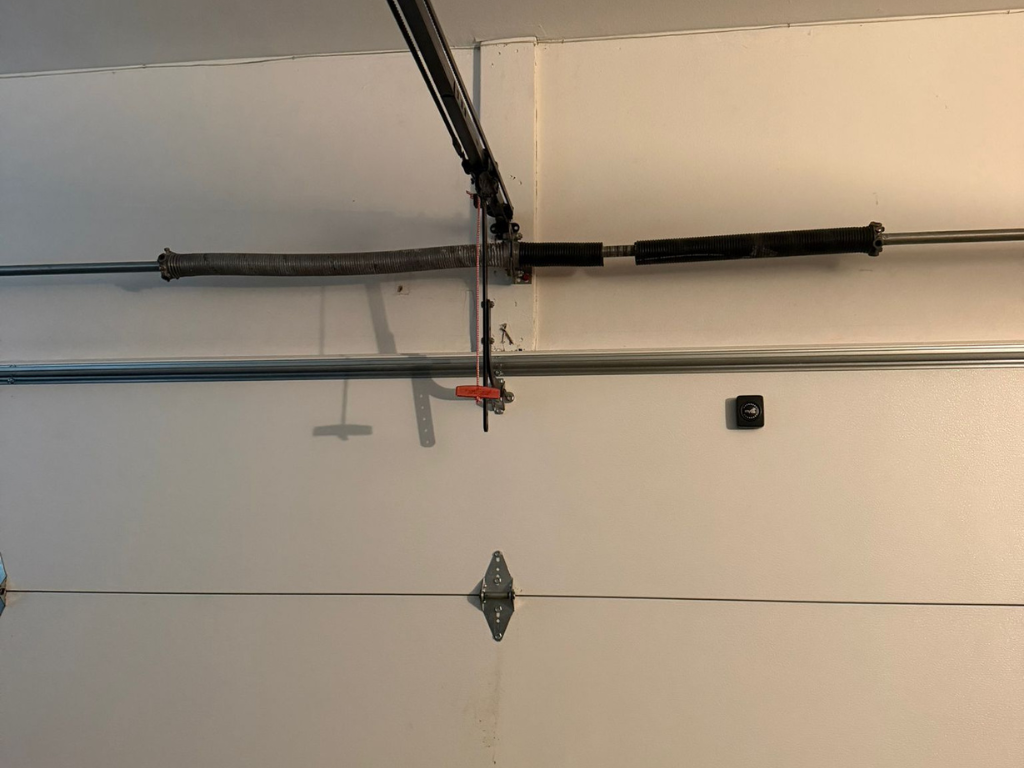
Garage door springs counterbalance the weight of the door. For a full breakdown of how spring systems work, see our complete guide to garage door springs. A properly balanced door may weigh hundreds of pounds, but the spring system makes that weight manageable during normal use. When a spring breaks, that counterbalance is greatly reduced or lost, and the door can suddenly become extremely heavy.
This is also why hitting the opener button over and over after a spring breaks is a bad idea. The opener is designed to move a properly balanced door. it isn’t built to replace the lifting force of a failed spring system. A broken spring is one of the most common reasons homeowners search for garage door repair Burbank – it’s a job for a trained technician, not a DIY fix.
How Does a Broken Spring Work With an Emergency Key Release?
If the garage has an exterior emergency key release, access becomes much more manageable for a garage door professional. The release system allows the opener to be disconnected without first entering the garage.
Disconnecting the opener, though, does not solve the broken spring. The door may still be extremely heavy, and its movement needs to be controlled carefully. In some cases, more than one technician or additional equipment is needed to safely manage the door and create access.
Once access is available, the spring system can be inspected and the appropriate repair performed. This is one of the clearest examples of why an exterior emergency release is worth having on a garage with no secondary entrance.
What Happens With a Broken Spring and No Emergency Release?
This is one of the tougher scenarios. Picture it:
- The garage door is closed.
- There’s no side entrance.
- There’s no access from the house.
- There’s no exterior emergency release.
- And the spring has broken.
Now the technician has to repair the broken spring and solve the problem of getting into the garage in the first place. Depending on the door, opener, spring system, construction, and available access, a garage door professional may need specialized techniques and equipment to establish access while protecting the door and opener.
This has to be done carefully. Forcing the door improperly can damage panels, tracks, rollers, cables, opener components, or other parts of the system.
Homeowners should never try to pry, force, or partially lift a door with a broken spring just to squeeze underneath it. A heavy, improperly supported garage door can move without warning. The goal is to gain access while minimizing risk to both people and the door system.
Why You Shouldn't Rely Only on Your Garage Door Remote
Plenty of homeowners keep one remote in each vehicle and never think about another way in. That works perfectly, right up until it doesn’t.
If the garage is reachable through the house, losing a remote is just an inconvenience. If the garage door is the only entrance, that same small problem can leave you completely locked out.
A solid access plan can include several layers:
- Garage door remote
- Exterior keypad
- Smartphone control when compatible
- Battery backup
- Exterior emergency key release
Not every garage needs every option. But a garage with only one entrance deserves extra thought, because there’s no simple fallback if the primary system fails.
Is an Exterior Keypad the Same as an Emergency Release?
No, and this distinction is important.
A keypad communicates with the opener and tells it to open the door. The opener still has to be working and capable of moving the door.
An emergency key release provides access to the manual release mechanism.
So a keypad is an excellent backup when a remote is lost, but it should never be treated as a replacement for an emergency release on a garage with no other entrance. And neither accessory repairs a broken spring. Each solves a different problem.
Do Smart Garage Door Openers Solve the Problem?
Smart garage door technology gives homeowners another handy access option. Depending on the opener and setup, a compatible smartphone app can control the door without a traditional remote. If your opener is aging or unreliable, a modern garage door opener with battery backup and smart control is worth considering. That’s convenient if your remote is lost or sitting in another vehicle.
But smart technology shouldn’t be confused with mechanical emergency access. If the opener itself fails, the spring breaks, or another mechanical problem stops the door from moving, an app can’t physically repair or release the door.
Technology adds a layer of convenience. Garages without secondary entrances still need a plan for mechanical access.
How Do You Prevent Getting Locked Out of Your Garage?
The best time to think about emergency garage access is before something breaks. If your garage door is the only way into your garage, check your current setup and ask:
- Do you have an exterior emergency key release?
- Does your opener have a battery backup?
- Do you have an exterior keypad?
- Is the opener compatible with smartphone control?
- Most importantly, is the garage door itself properly balanced and maintained?
Preventive garage door maintenance can catch worn springs, cables, rollers, opener problems, and balance issues before they turn into an emergency.
Should Every Garage Without a Side Door Have an Emergency Key Release?
In our view, yes. An exterior emergency key release is a very worthwhile addition when there’s no secondary entrance to the garage at all.
The device may rarely get used, and that’s a good thing. But if a power failure, opener problem, or other malfunction strikes, an established emergency access point can make a major difference. This matters most for detached garages, where the overhead door is literally the only way inside.
If you recently bought a home with this type of garage, checking for an existing emergency release should be part of your garage door inspection.
Plan Ahead to Avoid a Much Bigger Problem
A garage door that serves as the only entrance takes a little more planning than a conventional attached garage with multiple access points.
A lost remote may be solved with a keypad or smartphone control. A power outage may be handled by a battery backup. An opener failure may require access to the emergency release. A broken spring, on the other hand, is a mechanical problem that has to be handled differently, because the door can become extremely heavy.
The worst time to discover that your garage has no emergency access is after the door has already stopped working. If your garage has no side door, no entrance from the house, and no other way inside, consider having an exterior Emergency Key Release Lock installed before you actually need it. It’s a relatively simple addition that can turn a potentially complicated lockout into a much more manageable garage door service call.